Nomenclature
CAS number: 93-76-5
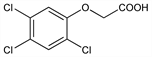
(2,4,5-Trichlorophenoxy)acetic acid; Esteron 245 (Dow); Trioxone (Zeneca).
C
8H
5Cl
3O
3; mol wt 255.48.
C 37.61%, H 1.97%, Cl 41.63%, O 18.79%.
Description and references
Post-emergence herbicide. Prepd from 2,4,5-trichlorophenol:
Pokorny, J. Am. Chem. Soc. 63, 1768 (1941); from benzenehexachloride: Galat, ibid. 74, 3890 (1952). Activity:
C. L. Hamner, T. B. Tukey, Science 100, 154 (1944). Contains trace levels of TCDD, q.v., as a contaminant: J.
Smith, Science 203, 1090 (1979); Chem. Eng. News 59, 6 (Jan. 5, 1981). Toxicity: V. A. Rowe, T. A. Hymas, Am. J. Vet. Res. 15, 622 (1954).
See also 2,4-D.
Properties
Crystals from benzene, mp 153°. d2020 1.80. Soly in water at 30°:
238 mg/kg. Sol in alcohol. Forms water-soluble sodium and alkanolamine
salts. Commercial products are usually in the form of amines or esters,
often in mixture with 2,4-D. LD50 orally in mice, rats: 389, 500 mg/kg (Rowe, Hymas).Caution
Potential symptoms of overexposure
in exptl animals are ataxia; skin irritation, acne-like rash; liver
damage. See NIOSH Pocket Guide
to Chemical Hazards (DHHS/NIOSH 97-140, 1997) p 292.Note
In March 1985 the E.P.A. terminated
all registrations for the use of this herbicide on rice fields, orchards,
sugarcane, rangeland and other noncrop sites. This follows the 1970
action of the Department of Agriculture halting the use of the pesticide
on all food crops except rice: Chem. Eng.
News 63, 6 (Mar. 25, 1985).Use
Formerly as herbicide.