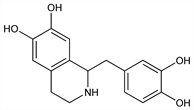
9216. Tetrahydropapaveroline
Nomenclature
Description and references
Alkaloid deriv of dopamine and a biosynthetic precursor of morphine, q.v. Prepn of the racemic hydrochloride: F. L. Pyman, J. Chem. Soc. 95, 1610 (1909); of the (+)- and (-)-form hydrochlorides: S. Teitel et al., J. Med. Chem. 15, 845 (1972). Chromatographic study: K. D. McMurtrey et al., J. Liq. Chromatogr. 3, 663 (1980). Possible role of THP in the biochemical mediation of alcohol addiction: V. E. Davis, M. J. Walsh, Science 167, 1005 (1970); G. Cohen, M. Collins, ibid. 1749; R. D. Meyers, C. L. Melchior, ibid. 196, 554 (1977); M. Sandler et al., Prog. Clin. Biol. Res. 90, 215 (1982). Biosynthetic study: D. K. Choudhary, B. L. Kaul, Indian Drugs 19, 229 (1982). In vivo and in vitro effects on rat pituitary function: D. R. Britton et al., Biochem. Pharmacol. 31, 1205 (1982). Effect on dopaminergic neurons: I. S. Hoffman, L. X. Cubeddu, J. Pharmacol. Exp. Ther. 220, 16 (1982). Comparison to opioid effects in brain regions: G. R. Siggins et al., Prog. Clin. Biol. Res. 90, 275 (1982).