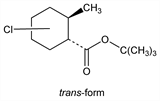
9701. Trimedlure
Nomenclature
Description and references
Synthetic sex pheromone developed as attractant for the Mediterranean fruit fly, or medfly, Ceratitis capitata (Weidemann). Prepn and physical props: M. Beroza et al., J. Agric. Food Chem. 9, 361 (1961). Commercial product consists mainly of the four isomers having the methyl and ester substituents on the ring in a trans configuration. Separation and identification of isomers: T. P. McGovern, M. Beroza, J. Org. Chem. 31, 1472 (1966). Extension of activity by fixatives: eidem, J. Econ. Entomol. 60, 379 (1967). Controlled release: S. Nakagawa et al., ibid. 72, 625 (1979). Repellent effect of high concns: eidem, ibid. 64, 762 (1971). Rate of loss from wicks: J. R. King, P. J. Landolt, ibid. 77, 221 (1984). Acute toxicity studies: M. Beroza et al., Toxicol. Appl. Pharmacol. 31, 421 (1975).