|
|
|
|
|
|
|
kinetics (e.g., absorption, half-life, variability) may account for a large proportion. Improving on success while minimizing these reasons for failure can be the management value added. |
|
|
|
|
|
|
|
|
Historically, many companies have organized in silos around functional skills (e.g., clinical pharmacology, drug metabolism, toxicology, etc.) focusing inward and missing the broader systems view (the big picture). In this case both process and functional skills are combined in the silo. More recently there has been movement to empower project teams to move projects across functional groups. In the team-based environment the team takes ownership of the project, while the functional areas are responsible for staffing and supporting teams. When there are many project teams, it is important for the functional groups to share best practices reaching agreements on the type of information that will be routinely collected, the order in which it will be collected, and how it will be used to help the project team make decisions. Information networks form in a more horizontal direction. |
|
|
|
|
|
|
|
|
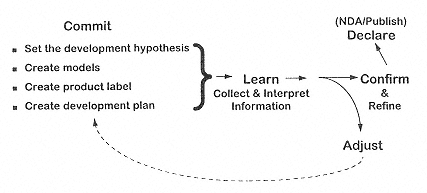
Expanding on the learn/confirm model advocated by Sheiner [16], Figure 7 might be the mission for the drug development project team. The simplest project team mission might be to create a development plan for the NCE. Teams should also be committed early to create models, to set hypotheses, and to create the target product label. Learning occurs as information is collected. If the information is not consistent with the original models or hypotheses, the plan may be adjusted. Eventually, either the information is declared in the form of a NDA or the project is stopped. |
|
|
|
|
|
|
|
|
Rewards for project teams are more common for achieving the development plan milestones on or before the planned date than for learning and adjusting to the information gained. Shifting from a time-based to a learning-based reward system is central to meeting the future R & D challenge [17]. Creating models is inherently appealing because they focus people on the critical |
|
|
|
|
|
|
|
|
Fig. 7
Drug development team mission and learning process. |
|
|
|
|
|