|
|
|
|
|
|
|
KPIs, which depended upon program deliverables, were developed for the key areas, and more general ones of efficiency and program criticality were used across the project. Monitoring actual costs against planned costs is of little use unless the achievement is also measured. The efficiency KPI used was |
|
|
|
|
|
|
|
|
 |
|
|
|
|
|
|
|
|
The criticality KPI was particularly useful because the project was large with multiple critical and subcritical paths to each major deliverable/milestone. A backward pass was calculated from the overall network and each subcritical path noted with its float. A graph shown in Fig. 5 was drawn with each critical/subcritical path showing the end date. This shows how the criticality of the activities was related to the deliverable date. Accordingly, management action could be prioritized by the degree of float appropriate to each activity with a problem. In this way, management time could be optimized by concentrating on those problems critical to the deliverable success, and the staff members knew where their tasks fitted into the overall plan and how critical their contributions were. |
|
|
|
|
|
|
|
|
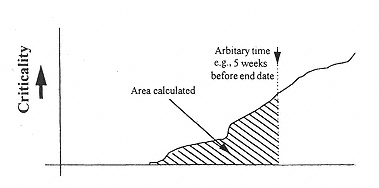
The criticality KPI represented a trend showing whether or not the program criticality was improving. An arbitrary date was chosen before the deliverable date (shown in Fig. 6 as 5 weeks). |
|
|
|
|
|
|
|
|
Then, the area under the graph was calculated and plotted as the Criticality KPI every week, as shown in Fig. 7. |
|
|
|
|
|
|
|
|
FIG. 6
The area of criticality: This area is a measure of how critical the
program is. |
|
|
|
|
|