305. Aloe
Description and references
Genus of succulent plants (family Liliaceae) having triangular, spear-like leaves with thorny ridges. Habit. Africa, southern Arabia, Madagascar. Naturalized in the West Indies, southern U.S., Central America, Asia. Several species have been used medicinally, primarily Aloe barbadensis Miller (also known as Aloe vera Linné, Curaao aloe, or Barbados aloe) and Aloe ferox Miller (also known as Cape aloe). “Drug aloe”, used as a cathartic, is the dried latex or bitter, yellow exudate from the leaf bundle sheath cells. The latex contains varying amounts of aloin, aloe-emodin, chrysophanic acid, q.q.v., volatile oil, and resins. Aloe vera gel is the fresh mucilaginous gel obtained from the parenchymatous tissue in the leaf center, used for its emollient and wound healing activity. Physical and chemical properties of the gel: Y.-T. Wang, K. J. Strong, Phytother. Res. 7, S1 (1993). Effects in wound healing: J. P. Heggers et al., ibid. S48. Reviews: D. Grindlay, T. Reynolds, J. Ethnopharmacol. 16, 117-151 (1986); A. D. Klein et al., J. Am. Acad. Dermatol. 18, 714-720 (1988); R. M. Shelton, Int. J. Dermatol. 30, 679-683 (1991).
Derivative
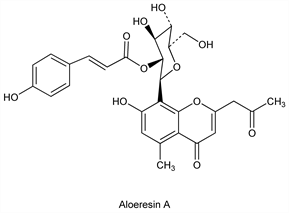
Aloeresin A.Nomenclature
Description and references
A major constituent of Cape aloe latex. Structure: P. Gramatica et al., Tetrahedron Lett. 23, 2423 (1982). HPLC determn in plant and commerical preparations: N. Okamura et al., J. Chromatogr. A 746, 225 (1996).
Properties
mp 148-150°. uv max in methanol: 228, 252, 300 nm (ε 34250, 25000, 37960).Therapeutic Category
Latex as laxative; gel as emollient, vulnerary.