817. Artemisinin
Nomenclature
Description and references
Active antimalarial constituent of the traditional Chinese medicinal herb Artemisia annua L., Compositae, which has been known for almost 2000 years as Qinghao. Isolated in 1972 and shown to be a sesquiterpene lactone with a peroxide moiety: K'o Hsueh T'ung Pao 22, 142 (1977), C.A. 87, 98788g (1977); L. Jing-Ming et al., Acta Chim. Sin. 37, 129 (1979), C.A. 92, 94594w (1980). Total synthesis and absolute configuration: G. Schmid, W. Hofheinz, J. Am. Chem. Soc. 105, 624 (1983). NMR spectral study: F. S. El-Feraly et al., Spectrosc. Lett. 18, 843 (1985). Antimalarial activity: Qinghaosu Antimalaria Coordinating Research Group, Chin. Med. J. 92, 811 (1979); L. J. Bruce-Chwatt, Br. Med. J. 284, 767 (1982). Clinical trials: J.-B. Jiang et al., Lancet 2, 285 (1982); W. Tongyin, X. Ruchang, J. Tradit. Chin. Med. 5, 240 (1985). Toxicity data: China Cooperative Research Group on Qinghaosu, ibid. 2, 31 (1982). Series of articles on chemistry, pharmacology, and antimalarial efficacy: ibid. 3-50. Brief reviews: H. Koch, Pharm. Int. 2, 184-185 (1981); D. L. Klayman, Science 228, 1049-1055 (1985). Review: R. N. Price, Expert Opin. Invest. Drugs 9, 1815-1827 (2000). Review of chemistry, pharmacology and clinical applications: X. D. Luo, C. C. Shen, Med. Res. Rev. 7, 29-52 (1987). Review of mechanism of action: S. R. Meshnick, Int. J. Parasitol. 32, 1655-1660 (2002).
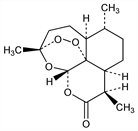
Properties
Needles, mp 156-157°. [α]D17 +66.3°. (c = 1.64 in CHCl3). Sol in most aprotic solvents. Slightly sol in oil. LD50 in mice (mg/kg): 5105 orally; 2800 i.m.; 1558 i.p. (Koch). LD50 in mice, rats (mg/kg): 4228, 5576 orally; 3840, 2571 i.m. (China Cooperative Research Group on Qinghaosu).Derivative
Dihydroartemisinin.Nomenclature
Description and references
Main metabolite of artemisinin, arteether, artemether, artesunate, qqv. HPLC determn: X.-D. Luo et al., Chromatographia 23, 112 (1987); in plasma: H. Naik et al., J. Chromatogr. B 816, 233 (2005).
Therapeutic Category
Antimalarial.
Keywords
Antimalarial