840. Aspartic Acid
Nomenclature
Description and references
Non-essential amino acid for human development. First identified as the acid hydrolysis product of asparagine, q.v.: A. Plisson, J. Pharm. 13, 477 (1827); later isolated from protein: H. Ritthausen, J. Prakt. Chem. 103, 233, 239 (1868). Early chemistry and biochemistry: Amino Acids and Proteins, D. M. Greenberg, Ed. (Charles C. Thomas, Springfield, IL, 1951) 950 pp., passim; J. P. Greenstein, M. Winitz, Chemistry of the Amino Acids vol 1-3 (John Wiley and Sons, Inc., New York, 1961) pp. 1856-1878, passim. Synthesis of optically active forms: K. Harada, K. Matsumoto, J. Org. Chem. 31, 2985 (1966); of labelled form: A. Ivanof et al., Anal. Biochem. 110, 267 (1981). Crystal structure: B. Dawson, Acta Crystallogr. 33B, 882 (1977). Excitatory neurotransmitter: H. McLennan, H. V. Wheal, Can. J. Physiol. Pharmacol. 54, 70 (1976). Role in protein activity: D. W. Urry et al., Biopolymers 34, 889 (1994); J. M. Denu et al., Biochemistry 34, 3396 (1995). Racemization with age in dentin: N. Saleh et al., Calcif. Tissue Int. 53, 103 (1993). Review of metabolism and pathology: L. D. Stegink, J. Toxicol. Environ. Health 2, 215-242 (1976). Review of role as excitatory amino acid: P. J. Roberts, S. W. Davies, Biochem. Soc. Trans. 15, 218-219 (1986); of use in forensics: E. R. Waite et al., Forensic Sci. Int. 103, 113-124 (1999); of pathobiology of age-related racemization in proteins: S. Ritz-Timme, M. J. Collins, Ageing Res. Rev. 1, 43-59 (2002).
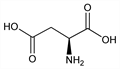
Properties
Orthorhombic bisphenoidal leaflets or rods, mp 270-271° (sealed capillary, preheated bath). [α]D20 +25.0° (c = 1.97 in 6N HCl). d12.5 1.661. pK1 1.88; pK2 3.65; pK3 9.60. Soly in water at 20°, 30°: 1 g/222.2 ml, 1 g/149.9 ml. Forms supersatd solns easily. More soluble in salt solns; sol in dilute solutions of mineral acids, alkalies. Practically insol in alcohol, ether.Derivative
d-Form.Nomenclature
Description and references
Occurs naturally although to a lesser extent than the l-form. Formed by non-enzymatic racemization in ageing protein. Purification and characterization from bovine lens: N. Fujii et al., Biochim. Biophys. Acta 999, 239 (1989); from tissue of the mollusc, Aplysia kurodai: M. Sato et al., Biochem. J. 263, 617 (1989). Review of industrial production by microorganisms: S. Takamatsu, T. Tosa, Bioprocess Technol. 16, 25-35 (1993).
Properties
[α]D25 2.0° (c = 3.93 in 5N HCl).Derivative
Compound with l-arginine.Nomenclature
Derivative
N-Acetyl-l-aspartic acid.Nomenclature
Description and references
Found in nervous system; second most abundant free amino acid in mammals. Review: D. L. Birken, W. H. Oldendorf, Neurosci. Biobehav. Rev. 13, 23-31 (1989).